EXPOSIÇÃO "OLTRE TERRA"
"OLTRE TERRA" exhibition
Exposição Coletiva Group Exhibition
National Museum, Oslo, NO.
Por by Formafantasma, curadoria de curated by Hanne Eide
26.05.2023 — 01.10.2023

© Alessandro Celli / Formafantasma
"Oltre Terra" é uma investigação em curso conduzida pelo estúdio de design Formafantasma, focada na história, ecologia e nas dinâmicas globais da produção e distribuição de produtos de lã e criação de ovelhas.
O nome da exposição deriva da etimologia da palavra transumância, formada pela junção das palavras latinas trans (across, 'oltre' em italiano) e humus (grounds, 'terra').
O projeto procura evitar a definição simplista de lã apenas como um material, e ampliar sua compreensão dentro de uma ecologia muito mais ampla. A lã é o ponto de partida para explorar e investigar um intrincado reino de interações e interdependências dentro de um ecossistema. Observando o desenvolvimento da produção de lã, a história dos artefactos e a cultura material, "Oltre Terra" procura revelar as complexidades da simbiose cooperativa entre animais, humanos e o meio ambiente.
O propósito da exposição é explorar essa relação muito íntima, mas intrincada, entre humanos e animais, na qual os limites entre domador e domesticado desaparecem. A cultura material e a evolução biológica são muitas vezes separadas conceptualmente, o que exige uma perspectiva holística sobre a interdependência entre os processos de produção e a evolução biológica.
/ Texto por Formafantasma
"Oltre Terra" is an ongoing investigation conducted by the design studio Formafantasma focused on the history, ecology, and global dynamics of the production and distribution of wool products and sheep farming.
The name of the exhibition stems from the etymology of the word transhumance, formed by the combination of the Latin words trans (across, 'oltre' in Italian) and humus (grounds, 'terra').
The project seeks to avoid the simplistic definition of wool as just a material, and to expand its understanding within a much broader ecology. Wool is the entry point to explore and investigate an intricate realm of interactions and interdependencies within an ecosystem. By looking at the development of wool production, artefacts history and material culture, Oltre Terra aims at unravelling the complexities of the cooperative symbiosis between animals, humans, and the environment.
The scope of the exhibition is to explore this very intimate, yet intricate relationship between humans and animals, in which the boundaries between tamer and domesticated fade. Material culture and biological evolution are too often conceptually separated, which calls for a holistic perspective on the interdependency between production processes and biological evolution.
/ Text by Formafantasma

Vista geral da exposição. General view of the exhibition.
© Gregorio Gonella / Formafantasma
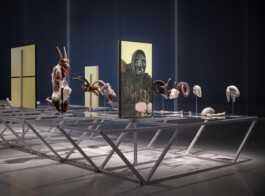
Vista da secção 7 da exposição. View of section 7 of the exhibition.
© Ina Wesenberg / Formafantasma
Fui convidado a participar na "Oltre Terra" com o vídeo A Fala das Cabras e dos Pastores, que integrou a secção 2 — "We all need other species to live" da exposição.
I was invited to participate in "Oltre Terra" with the video A Fala das Cabras e dos Pastores ("The speech of goats and shepherds"), which was part of section 2 — "We all need other species to live" of the exhibition.
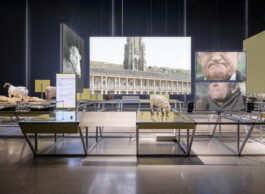
Vista da secção 2 da exposição. View of section 2 of the exhibition.
© Ina Wesenberg / Formafantasma
Vídeo "A Fala das Cabras e dos Pastores". Video "The speech of goats and shepherds"
Alexandre Delmar, 2015.

Vista do vídeo "A Fala das Cabras e dos Pastores". View of "The speech of goats and shepherds".
© Gregorio Gonella / Formafantasma
Secção 2 — Todos precisamos de outras espécies para viver
/ Por Emanuele Coccia
A pastorícia é a expressão da relação simbiótica entre humanos, animais, plantas e meio ambiente, representando uma prática milenar que vê a coexistência de todas as suas partes. A transumância, o movimento sazonal entre montanhas (no verão) e planícies (no inverno), é uma das poucas práticas nómadas que restam ainda ativas na Europa.
A co-domesticação ocorre em diferentes escalas e entre várias espécies: plantas, como a Agrimonia eupatoria, podem colonizar novos territórios quando se enredam na lã de ovelha; os cães pastores dominaram habilidades surpreendentes para gerir e colaborar com o rebanho. O ambiente também desempenha um papel crucial: raças ovinas como a Ciuta evoluíram para viver em áreas montanhosas. A sua leveza e agilidade tornaram-nas adequadas ao difícil contexto dos Alpes, contribuindo para manter níveis benéficos de biodiversidade dentro do ecossistema. Através da pastorícia, os humanos desenvolveram dispositivos para interagir com os animais. Sinos de ovelha e cajados de pastor tornaram-se uma extensão do aparato sensorial do pastor. Da mesma forma, também aprenderam a comunicar com ovelhas e cães, através de ruídos, sons e assobios. Os lobos, habitantes das mesmas áreas montanhosas, estão no centro dos debates entre aqueles que desejam protegê-los e aqueles que os veem como uma ameaça aos rebanhos. Apesar de terem sido quase inteiramente extirpados artificialmente ao longo dos séculos XIX e XX, o reaparecimento dos lobos nas últimas décadas está diretamente relacionado à mudança de fatores socioeconómicos e demográficos que levaram ao despovoamento das áreas montanhosas remotas. Os pastores transumantes enfrentam hoje dificuldades crescentes relacionadas com a sua sustentabilidade económica, a crescente fragmentação e privatização das terras e os crescentes problemas relacionados com as alterações climáticas.
Section 2 — We all need other species to live
/ By Emanuele Coccia
Pastoralism is the expression of the symbiotic relationship between humans, animals, plants, and the environment, representing a millenarian practice that sees the co-existence of all of its parts. Transhumance, the seasonal movement between mountains (in the summer) and flatlands (in the winter), is one of the few remaining nomadic practices still active today in Europe.
Co-domestication takes place at different scales and between various species: plants, such as the agrimonia eupatoria, can colonise new territories when they get entangled in sheep’s wool; shepherd dogs have mastered astonishing skills to manage and collaborate with the flock. The environment also plays a crucial role: sheep breeds such as the Ciuta have evolved to live in mountainous areas. Their light weight and agility makes them suitable to the difficult environment of the Alps, contributing to keeping beneficial levels of biodiversity within the ecosystem. Through pastoralism, humans have developed devices to interface with animals. Sheep bells and shepherd crooks have become an extension of the shepherd’s sensorial apparatus. Similarly, they have also learned how to communicate with sheep and dogs, through noises, sounds, and whistles. Wolves, inhabitants of the same mountainous areas, are at the centre of debates between those who wish to protect them, and those who see them as a threat to flocks. Despite having been almost entirely artificially extirpated throughout the 19th and 20th centuries, the reappearance of wolves over the last decades is directly connected to the changing socio-economic factors and shifting demographics that have led to the depopulation of remote mountainous areas. Transhumant shepherds today are facing increasing difficulties, related to their economic sustainability, the ever growing fragmentation and privatisation of the lands, and the increasing problems connected to climate change.
Vídeo da exposição. Exhibition video.
© Formafantasma
ANO YEAR · 2023
LOCAL LOCATION · National Museum, Oslo, NO.
CONCEPT & DESIGN Conceito e design · Formafantasma (Andrea Trimarchi, Simone Farresin)
TEAM Equipa · Sara Barilli, Alessandro Celli, Gregorio Gonella, Hannah Segerkrantz
curadoria da Exposição EXHIBITION CURATED BY · Hanne Eide
AGRADECIMENTOS SPECIAL THANKS · Gregorio Gonella
EXPOSIÇÃO
"OLTRE TERRA"
"OLTRE TERRA"
exhibition
Exposição Coletiva Group Exhibition
National Museum, Oslo, NO.
Por by Formafantasma, curadoria de curated by Hanne Eide
26.05.2023 — 01.10.2023
© Alessandro Celli / Formafantasma
"Oltre Terra" é uma investigação em curso conduzida pelo estúdio de design Formafantasma, focada na história, ecologia e nas dinâmicas globais da produção e distribuição de produtos de lã e criação de ovelhas.
O nome da exposição deriva da etimologia da palavra transumância, formada pela junção das palavras latinas trans (across, 'oltre' em italiano) e humus (grounds, 'terra').
O projeto procura evitar a definição simplista de lã apenas como um material, e ampliar sua compreensão dentro de uma ecologia muito mais ampla. A lã é o ponto de partida para explorar e investigar um intrincado reino de interações e interdependências dentro de um ecossistema. Observando o desenvolvimento da produção de lã, a história dos artefactos e a cultura material, "Oltre Terra" procura revelar as complexidades da simbiose cooperativa entre animais, humanos e o meio ambiente.
O propósito da exposição é explorar essa relação muito íntima, mas intrincada, entre humanos e animais, na qual os limites entre domador e domesticado desaparecem. A cultura material e a evolução biológica são muitas vezes separadas conceptualmente, o que exige uma perspectiva holística sobre a interdependência entre os processos de produção e a evolução biológica.
/ Texto por Formafantasma
"Oltre Terra" is an ongoing investigation conducted by the design studio Formafantasma focused on the history, ecology, and global dynamics of the production and distribution of wool products and sheep farming.
The name of the exhibition stems from the etymology of the word transhumance, formed by the combination of the Latin words trans (across, 'oltre' in Italian) and humus (grounds, 'terra').
The project seeks to avoid the simplistic definition of wool as just a material, and to expand its understanding within a much broader ecology. Wool is the entry point to explore and investigate an intricate realm of interactions and interdependencies within an ecosystem. By looking at the development of wool production, artefacts history and material culture, Oltre Terra aims at unravelling the complexities of the cooperative symbiosis between animals, humans, and the environment.
The scope of the exhibition is to explore this very intimate, yet intricate relationship between humans and animals, in which the boundaries between tamer and domesticated fade. Material culture and biological evolution are too often conceptually separated, which calls for a holistic perspective on the interdependency between production processes and biological evolution.
/ Text by Formafantasma
Vista geral da exposição. General view of the exhibition.
© Gregorio Gonella / Formafantasma
Vista da secção 7 da exposição. View of section 7 of the exhibition.
© Ina Wesenberg / Formafantasma
Fui convidado a participar na "Oltre Terra" com o vídeo A Fala das Cabras e dos Pastores, que integrou a secção 2 — "We all need other species to live" da exposição.
I was invited to participate in "Oltre Terra" with the video A Fala das Cabras e dos Pastores ("The speech of goats and shepherds"), which was part of section 2 — "We all need other species to live" of the exhibition.
Vista da secção 2 da exposição. View of section 2 of the exhibition.
© Ina Wesenberg / Formafantasma
Vídeo "A Fala das Cabras e dos Pastores". Video "The speech of goats and shepherds"
Alexandre Delmar, 2015.
Vista do vídeo "A Fala das Cabras e dos Pastores". View of "The speech of goats and shepherds".
© Gregorio Gonella / Formafantasma
Secção 2 — Todos precisamos de outras espécies para viver
/ Por Emanuele Coccia
A pastorícia é a expressão da relação simbiótica entre humanos, animais, plantas e meio ambiente, representando uma prática milenar que vê a coexistência de todas as suas partes. A transumância, o movimento sazonal entre montanhas (no verão) e planícies (no inverno), é uma das poucas práticas nómadas que restam ainda ativas na Europa.
A co-domesticação ocorre em diferentes escalas e entre várias espécies: plantas, como a Agrimonia eupatoria, podem colonizar novos territórios quando se enredam na lã de ovelha; os cães pastores dominaram habilidades surpreendentes para gerir e colaborar com o rebanho. O ambiente também desempenha um papel crucial: raças ovinas como a Ciuta evoluíram para viver em áreas montanhosas. A sua leveza e agilidade tornaram-nas adequadas ao difícil contexto dos Alpes, contribuindo para manter níveis benéficos de biodiversidade dentro do ecossistema. Através da pastorícia, os humanos desenvolveram dispositivos para interagir com os animais. Sinos de ovelha e cajados de pastor tornaram-se uma extensão do aparato sensorial do pastor. Da mesma forma, também aprenderam a comunicar com ovelhas e cães, através de ruídos, sons e assobios. Os lobos, habitantes das mesmas áreas montanhosas, estão no centro dos debates entre aqueles que desejam protegê-los e aqueles que os veem como uma ameaça aos rebanhos. Apesar de terem sido quase inteiramente extirpados artificialmente ao longo dos séculos XIX e XX, o reaparecimento dos lobos nas últimas décadas está diretamente relacionado à mudança de fatores socioeconómicos e demográficos que levaram ao despovoamento das áreas montanhosas remotas. Os pastores transumantes enfrentam hoje dificuldades crescentes relacionadas com a sua sustentabilidade económica, a crescente fragmentação e privatização das terras e os crescentes problemas relacionados com as alterações climáticas.
Section 2 — We all need other species to live
/ By Emanuele Coccia
Pastoralism is the expression of the symbiotic relationship between humans, animals, plants, and the environment, representing a millenarian practice that sees the co-existence of all of its parts. Transhumance, the seasonal movement between mountains (in the summer) and flatlands (in the winter), is one of the few remaining nomadic practices still active today in Europe.
Co-domestication takes place at different scales and between various species: plants, such as the agrimonia eupatoria, can colonise new territories when they get entangled in sheep’s wool; shepherd dogs have mastered astonishing skills to manage and collaborate with the flock. The environment also plays a crucial role: sheep breeds such as the Ciuta have evolved to live in mountainous areas. Their light weight and agility makes them suitable to the difficult environment of the Alps, contributing to keeping beneficial levels of biodiversity within the ecosystem. Through pastoralism, humans have developed devices to interface with animals. Sheep bells and shepherd crooks have become an extension of the shepherd’s sensorial apparatus. Similarly, they have also learned how to communicate with sheep and dogs, through noises, sounds, and whistles. Wolves, inhabitants of the same mountainous areas, are at the centre of debates between those who wish to protect them, and those who see them as a threat to flocks. Despite having been almost entirely artificially extirpated throughout the 19th and 20th centuries, the reappearance of wolves over the last decades is directly connected to the changing socio-economic factors and shifting demographics that have led to the depopulation of remote mountainous areas. Transhumant shepherds today are facing increasing difficulties, related to their economic sustainability, the ever growing fragmentation and privatisation of the lands, and the increasing problems connected to climate change.
Vídeo da exposição. Exhibition video.
© Formafantasma
ANO YEAR · 2023
LOCAL LOCATION · National Museum, Oslo, NO.
CONCEPT & DESIGN Conceito e design · Formafantasma (Andrea Trimarchi, Simone Farresin)
TEAM Equipa · Sara Barilli, Alessandro Celli, Gregorio Gonella, Hannah Segerkrantz
curadoria da Exposição EXHIBITION CURATED BY · Hanne Eide
AGRADECIMENTOS SPECIAL THANKS · Gregorio Gonella